
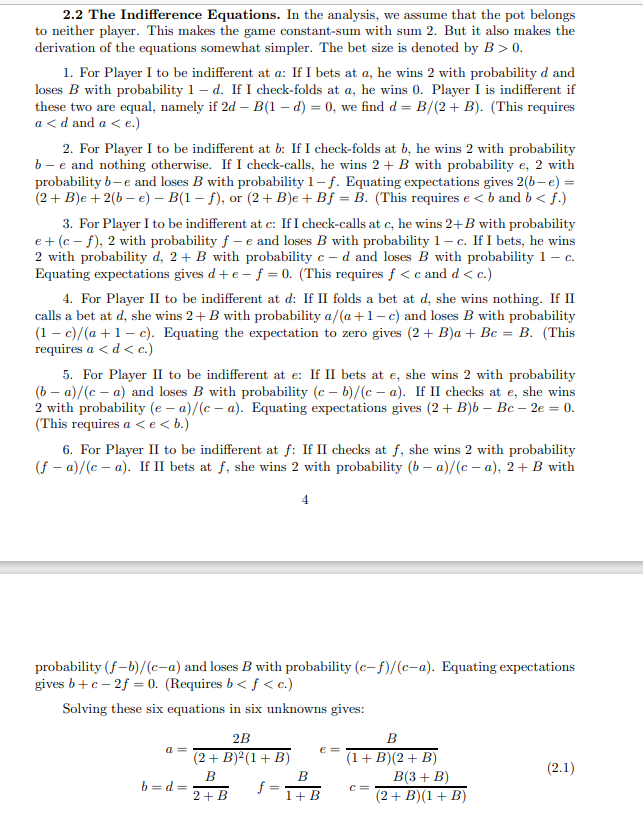
au passage "solving these 6 equations gives......" j'ai pas compris comment il arrivait à déduire la valeur de, par exemple, a = 2B/(2+B)²(1+B)
 par pariAAboy » 07 Jan 2022, 17:52
par mathelot » 07 Jan 2022, 18:52
par pariAAboy » 09 Jan 2022, 14:56
tart with the given 6 equations:
(1) d = B / (2 + B)
(2) (2 + B)e + Bf = B
(3) d + e - f = 0
(4) (2 + B)a + Bc = B
(5) (2 + B)b - Bc - 2e = 0
(6) b + c - 2f = 0
We are trying to find expressions for a, b, c, d, e, and f just in terms of B. Notice first that equation (1) accomplishes this for d, so one down, 5 to go.
Next, substitute (1) into (3) to arrive at B / (2 + B) + e - f = 0
Multiply by (2 + B) to get B + (2 + B)e - (2+B)f = 0
This looks similar to (2), so add Bf to both sides to get B + (2+B)e + Bf - (2+B)f = Bf
Now, use (2) to replace a portion of the left hand side: B + B - (2+B)f = Bf
Moving the f term to the right side and factoring: 2B = f(2 + 2B)
Divide both sides by (2 + 2B) and cancel a factor of 2 to get f = B / (1 + B)
Now, sub into (3): B/(2+B) + e - B/(1+B) = 0
Rearrange: e = B/(1+B) - B/(2+B) = [(2 + B)B - (1+B)B]/[(1+B)(2+B)] = [B^2 + 2B - B^2 - B][(1+B)(2+B)] = B/[(1+B)(2+B)]
So far, we have successfully solved for d, e, and f. Now for a, b, and c.
Start with equation (6) and sub in the value for f: b + c - 2B/(1+B) = 0 [A]
Then take equation (5) and sub in the expression for e: (2+B)b - Bc - 2B/[(1+B)(2+B)] = 0 [B]
Multiple [A] by B to get Bb + Bc - 2B^2/(1+B) = 0
Add this to [B] (notice that the c terms cancel) to get (2 + 2B)b - 2B^2/(1+B) - 2B/[(1+B)(2+B)] = 0
Simplify a little bit: (2 + 2B)b = [2B^2(2+B) + 2B]/[(1+B)(2+B)] = [2B(B^2 + 2B +1]/[(1+B)(2+B)] = [2B(1+B)^2]/[(1+B)(2+B)] = [2B(1+B)]/(2+B)
Divide both sides by (2 + 2B): b = B/(2+B)
Now, plug this back into (6): B/(2+B) + c - 2B/(1+B) = 0
Rearrange: c = 2B/(1+B) - B/(2+B) = [4B + 2B^2 - B - B^2]/[(1+B)(2+B)] = [B(3+B)] / [(1+B)(2+B)]
Now, all that is left is to solve for a.
Use (4): (2+B)a + B[B(3+B)] / [(1+B)(2+B)] = B
So (2+B)a = B - [B^2(3+B)] / [(1+B)(2+B)]
Divide by (2+B): a = B/(2+B) - [B^2(3+B)] / [(1+B)(2+B)^2] = [B(1+B)(2+B) - B^2(3+B)]/[(1+B)(2+B)^2] = [B(B^2 + 3B + 2 - 3B - B^2)]/[(1+B)(2+B)^2] = 2B/[(1+B)(2+B)^2]

par mathelot » 09 Jan 2022, 15:31
par pariAAboy » 09 Jan 2022, 15:35
mathelot a écrit:re,
que veut dire check-folds et check-calls ?
quelle est la nature du jeu ? cartes, poker ? roulette ? jeu abstrait ?
par pariAAboy » 09 Jan 2022, 15:35
Now, let's look at what we have:
[equation 1] b + c - 2B/(1+B) = 0
[equation 2] (2+B)b - Bc - 2B/[(1+B)(2+B)] = 0
One manipulation I can do is to add the left sides of these two equations and also add the right sides together. But before I do that, I'm going to plan ahead so that when I add them, one of the variables cancels out. Notices that we have a c term in [equation 1] and a -Bc term in [equation 2]. These wouldn't cancel yet, but if I multiplied [equation 1] by B, when I add them, the c terms would do away. Let's do that:
B*[equation 1] Bb + Bc - 2B^2 / (1+B) = 0
[equation 2] (2+B)b - Bc - 2B/[(1+B)(2+B)] = 0
Now notice that if I add the top equation to the bottom, the c terms cancel and I'm left with: Bb + (2+B)b - 2B^2/(1+B) - 2B/[(1+B)(2+B)] = 0
Utilisateurs parcourant ce forum : Aucun utilisateur enregistré et 38 invités
Tu pars déja ?
Identification
Pas encore inscrit ?
Ou identifiez-vous :